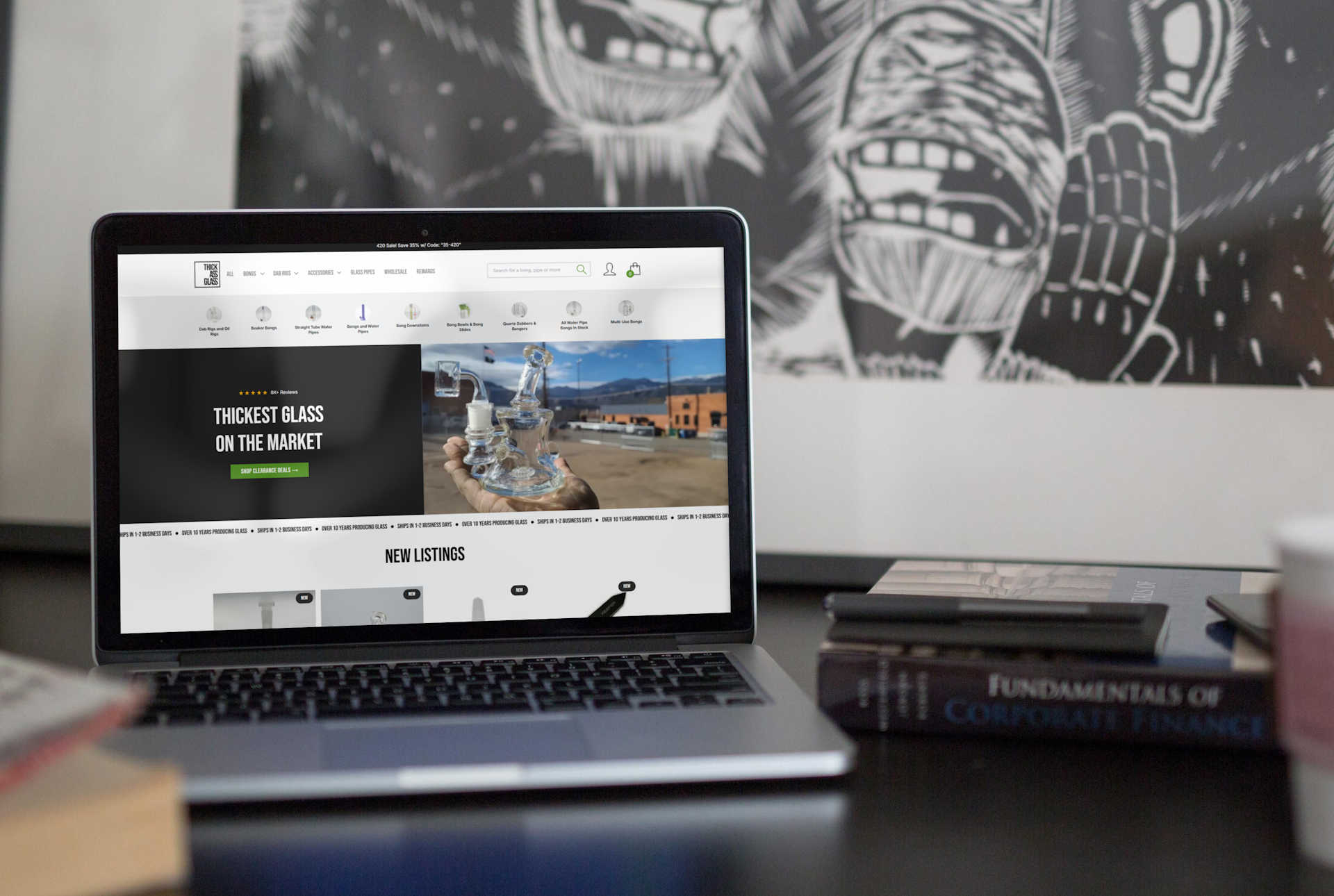
In an industry often driven by trends and flashy aesthetics, Thick Ass Glass (TAG) has carved out its niche by focusing on something more fundamental: engineering excellence. Since 2013, TAG has been producing some of the most durable, functional glass smoking accessories on the market, earning a dedicated following among enthusiasts who value performance over hype. I recently sat down with Brian Handschuh, the founder and visionary behind TAG, to discuss the importance of glass density in diffusion, how TAG’s warranty program reflects their confidence in their products, the environmental considerations in glass production, and why education has become central to the company’s mission.
Diego: Brian, thanks for making time for this conversation. To start, could you explain how TAG’s approach to glass density differs from industry standards, and why that matters for the actual smoking experience?
Brian: Thanks for having me, Diego. Glass density is one of those technical aspects that doesn’t get enough attention but makes a huge difference in everyday use. When we talk about “thick” glass, we’re not just referring to durability—though that’s certainly a benefit. The density and mass of the glass actually affect how heat transfers, how the piece balances in your hand, and even how smoke diffuses through water.
Most mass-produced pieces use 3-5mm glass to save on material costs. At TAG, our beakers feature bases up to 18mm thick, and even our walls are typically 7-9mm. This additional mass creates a heat sink effect, which helps maintain consistent temperatures throughout your session. It also provides the structural integrity needed for proper percolation—thinner glass can flex slightly under vacuum pressure, which affects how bubbles form and how smoke travels through water.
But there’s a balance to strike. Go too thick, and the piece becomes unwieldy or the production costs skyrocket. Our engineering team works to identify exactly where thickness matters most—stress points, heat contact areas, and structural supports—while keeping other areas optimized for weight and function.
Diego: You mentioned percolation. Could you break down how diffusion actually works and why TAG’s approach to percolator design stands out?
Brian: At its core, percolation is about breaking smoke into smaller bubbles to increase the surface area that comes in contact with water, which cools and filters the smoke. The science is straightforward—smaller bubbles mean more surface area, which means more efficient cooling and filtering—but the execution is where most manufacturers fall short.
Many brands add percolators because they look impressive, not because they’ve tested how they actually function. They’ll throw in tree percs with too few arms, or honeycomb percs with holes that are too large or too small, creating either excessive drag or ineffective diffusion.
At TAG, we engineer our percolators with specific slit counts and hole sizes based on fluid dynamics testing. Our super slit pucks, for instance, feature more slits than industry standard, creating optimal-sized bubbles without restricting airflow. This is more difficult and time-consuming to produce, but the performance difference is substantial.
We also pay attention to the interaction between percolators in multi-chamber designs. The airflow from one perc affects how the next one functions, so we calculate these relationships carefully. It’s why some of our most popular pieces don’t have the most complex-looking percolation systems—they have the most effective ones.
The real test is in the experience. Properly diffused smoke is noticeably smoother and cooler, without requiring excessive lung power to pull through the piece. It’s something you feel immediately when comparing a well-engineered piece to a standard one.
Diego: TAG offers a warranty program that’s somewhat unique in the industry. How does this program reflect your confidence in your products, and what has the customer response been like?
Brian: Our warranty program comes from a simple principle: if we’re going to talk about making superior, durable glass, we should be willing to stand behind that claim.
The program is straightforward—customers can purchase coverage that protects their investment against accidental damage. It’s not the typical manufacturer’s warranty that only covers defects; it actually protects against the kinds of accidents that happen in real life.
This approach reflects our fundamental confidence in our engineering. We know our glass is significantly more durable than industry standard, so we can offer this kind of protection while still making it financially viable.
The customer response has been overwhelmingly positive for two reasons. First, it provides peace of mind. Many people have been through the cycle of buying and breaking cheaper glass, so knowing they’re protected creates a different relationship with their piece. They can actually enjoy using it without constant worry.
Second, it changes the value equation. A quality piece with protection often costs less in the long run than repeatedly replacing cheaper options. Customers appreciate that we’re thinking about their experience beyond just the initial sale.
What’s been particularly interesting is seeing how the warranty program has shifted purchasing behavior. People are more willing to invest in higher-quality, more complex pieces when they know they’re protected. It’s removed a significant barrier to experiencing the benefits of better-engineered glass.
Diego: Let’s talk about environmental considerations. How does TAG approach sustainability in its production process, and what challenges exist in making glass smoking accessories more environmentally friendly?
Brian: Environmental impact is something we think about constantly, though it doesn’t always get highlighted in our marketing. Glass production is inherently energy-intensive, so we focus on making pieces that last for years rather than months, which reduces the overall environmental footprint through longevity.
We’ve also invested significantly in optimizing our production processes. Our furnaces use energy-efficient technologies that reduce consumption compared to traditional methods. We recycle all glass waste from production back into new pieces, creating a closed-loop system for manufacturing scraps.
Packaging is another area where we’ve made improvements. We’ve reduced plastic use by over 60% in the past three years, switching to recyclable and biodegradable materials wherever possible without compromising protection during shipping.
The biggest challenge in our industry is balancing environmental concerns with safety and durability requirements. Certain materials or processes might be more eco-friendly but don’t provide the heat resistance or structural integrity needed for a quality smoking accessory. We’re constantly researching new materials and techniques that might allow us to further reduce our environmental impact without compromising performance.
Another industry-specific challenge is the energy required for proper annealing—the cooling process that makes glass more durable. Rushing this process saves energy but creates glass that breaks more easily, which is worse for the environment in the long run. We’ve invested in specialized annealing ovens that use less energy while still allowing for the proper cooling time.
Ultimately, we believe making products that last is the most environmentally responsible approach. Every TAG piece that stays in use for years instead of months represents significant resource savings compared to the cycle of producing, shipping, and disposing of multiple cheaper pieces.
Diego: Education seems to be a significant part of TAG’s approach to the market. Why have you put so much emphasis on teaching customers about glass quality and function rather than just selling products?
Brian: Education has become central to our mission because an informed customer makes better decisions and appreciates quality engineering. When people understand why thicker glass matters, how percolation affects their experience, or what makes a joint durable, they value those features rather than just focusing on price or aesthetics.
We’ve invested heavily in creating content that explains the science behind different designs. Our blog articles break down complex topics like percolation physics, material properties, and airflow dynamics in accessible language. We’re not just saying “our glass is better”—we’re explaining exactly why and how it’s better.
This educational approach serves multiple purposes. First, it helps customers make more informed purchases that better match their actual needs, which leads to higher satisfaction. Someone who understands the trade-offs between different perc designs is more likely to choose one that suits their preferences.
Second, it elevates the entire conversation around quality in our industry. When customers start asking more sophisticated questions about glass thickness, joint strength, or percolation efficiency, it pushes all manufacturers to improve their standards or at least be more transparent about their products.
Finally, education creates a different kind of customer relationship. Rather than the typical transactional approach of “here’s what we sell, buy it or don’t,” we’re engaging in a dialogue about what makes for a better smoking experience. This builds trust and loyalty that goes beyond any individual purchase.
The response has been incredible. We regularly hear from customers who say they came to TAG looking for a product but stayed for the education. Many tell us they’ve completely changed how they evaluate glass based on what they’ve learned from our content.
Diego: Different smokers have different preferences when it comes to their experience. How does TAG approach designing for varying preferences while maintaining quality standards?
Brian: This is one of the most interesting challenges in our design process. Smoking preferences are deeply personal—some people want maximum filtration and cooling, others prefer more direct flavor, some want huge rips, others prefer smaller, more controlled hits.
Our approach is to maintain consistent quality standards while creating distinct product lines that cater to different experience preferences. For example, our beaker bongs with diffused downstems provide a traditional, versatile experience with moderate filtration. Our multi-chamber percolator pieces deliver maximum cooling and filtration for those who want the smoothest possible hit. Our recyclers offer enhanced flavor preservation while still providing good filtration.
We also consider the different materials people consume. Flower smokers often want more water volume and percolation, while concentrate users typically prefer smaller chambers with less diffusion to preserve flavor profiles. We engineer our dab rigs specifically for concentrate use rather than just scaling down our bong designs.
The Made To Order service we launched in 2021 takes this customization even further, allowing customers to request specific variants of almost any item we offer. This gives people the ability to fine-tune their experience while still benefiting from our engineering standards.
Throughout all these variations, we maintain our core quality principles: proper glass thickness at stress points, precision joint work, annealed borosilicate material, and optimal airflow engineering. The experience may differ between products, but the durability and function remain consistently high.
We’ve found that this approach—maintaining quality standards while offering experiential variety—creates customers who often own multiple TAG pieces for different occasions or materials. They might have a beaker for everyday use, a recycler for concentrates, and a multi-perc piece for sessions where maximum filtration is desired.
Diego: The industry has seen a lot of innovation in recent years. How do you balance incorporating new ideas while maintaining your focus on proven engineering principles?
Brian: That’s a fantastic question that gets to the heart of our product development philosophy. Innovation is essential for growth, but not all innovations actually improve the smoking experience. Some are purely aesthetic, others might look impressive but create functional problems like excessive drag or difficult cleaning.
Our approach to innovation starts with questioning whether a new design or feature actually solves a problem or enhances the experience in a measurable way. We’re not interested in novelty for novelty’s sake.
When we do adopt new concepts, we put them through rigorous testing against our established engineering standards. Does this new percolator design actually cool smoke more effectively? Does this new joint design actually increase durability? Does this new chamber configuration actually improve flavor preservation? If the answers aren’t clearly “yes,” we don’t move forward.
A good example is our approach to recyclers. When recyclers started gaining popularity, many companies rushed designs to market that looked the part but didn’t function properly. The water wouldn’t actually recycle consistently, or the drain rates weren’t calibrated correctly. We spent over a year testing different configurations before releasing our first recycler designs, ensuring they delivered on the functional promise of the concept.
We’ve also innovated in less visible ways that make a big difference in performance. Our joint connections are engineered with specific tolerances that create better seals while reducing stress fractures. Our downstem angles are calculated to create optimal bubble formation. These aren’t flashy innovations that show up in product photos, but they significantly impact the daily experience.
The best innovations often come from customer feedback rather than industry trends. When multiple customers identify a similar pain point—like splash-back from certain perc designs or cleaning difficulties in specific configurations—that drives our most useful innovations.
Diego: Community has clearly played a significant role in TAG’s growth. How has feedback from platforms like Reddit influenced your approach to product development and customer service?
Brian: The online community, especially on platforms like Reddit, has been invaluable to our development as a company. These spaces provide unfiltered, authentic feedback that you simply can’t get through traditional market research or focus groups.
We actively monitor threads where people discuss their experiences with our products and our competitors’. What’s particularly valuable is that these conversations happen organically without our prompting—people are just sharing their honest experiences, positive and negative.
This feedback has directly influenced numerous product improvements. For example, we noticed multiple users mentioning that certain percolator designs were difficult to clean properly. Rather than dismissing this as an inevitable trade-off for performance, we redesigned those percs to maintain the same diffusion quality while making them more accessible for cleaning tools.
Another example is our approach to warranty service. After seeing discussions about the frustration of navigating complex warranty claims with other companies, we streamlined our process to be as straightforward as possible. We don’t make customers jump through hoops to prove their purchase is legitimate or their claim is valid.
The Reddit community has also helped spread awareness of quality differences in general. As users share side-by-side comparisons of glass thickness, joint strength, and percolation effectiveness, it educates the entire market about what makes a piece worth investing in. This benefits us because we’ve focused on those engineering fundamentals from the beginning.
What I personally love about these community platforms is that they cut through marketing hype quickly. You can make all kinds of claims in your advertising, but if the product doesn’t deliver, the community will call it out. Conversely, when you make something genuinely good, word spreads organically. That’s been a significant driver of our growth—people sharing their positive experiences without us prompting them to do so.
Diego: One interesting service you offer is the Made To Order option. How did that come about, and what has the response been like?
Brian: The Made To Order service evolved directly from customer requests. For years, people would contact us asking for specific variants that weren’t currently available—different colors, joint sizes, or feature combinations that we hadn’t produced as standard offerings.
Traditionally, production glass brands couldn’t accommodate these requests because they required high production quantities of specific variants to be cost-effective. But we kept hearing the same desire: “I love this design, but I wish it had this specific feature.”
In early 2021, we decided to find a way to make customization accessible. We developed a production system that allowed for smaller batch runs without dramatically increasing costs. This meant we could offer customized pieces at prices only moderately higher than our standard production items.
The response has been overwhelming. Customers love being able to get exactly what they want rather than settling for the closest available option. We’ve created everything from custom color combinations to unique perc configurations based on individual requests.
What’s been particularly interesting is seeing how this service has changed customer relationships with their pieces. When someone has input into the design, they develop a stronger connection to the final product. These aren’t just functional tools anymore; they’re expressions of personal preference.
The Made To Order service has also become a valuable source of product development insights. When we see multiple customers requesting similar customizations, it indicates an unmet need in our standard lineup. Several of our current production pieces began as popular Made To Order configurations that we eventually added to the regular catalog.
From a business perspective, it’s created a unique competitive advantage. Few companies our size can offer this level of customization without charging premium art glass prices. It’s another way we’re bridging the gap between mass-produced glass and custom artisan work.
Diego: To wrap up our conversation, what’s one piece of advice you’d give to someone just beginning to explore quality glass, and what’s one insider tip that even experienced users might not know?
Brian: For beginners, my advice is simple but often overlooked: start with a versatile, well-made piece rather than chasing the most complex or visually impressive option. A quality beaker bong or straight tube with a good diffused downstem will provide a better experience than a cheap multi-chamber piece with fancy but poorly engineered percs.
Focus on the fundamentals: glass thickness (especially at the base and joints), proper annealing (quality glass won’t have visible stress marks when viewed through polarized light), and basic functionality. A well-engineered simple piece will outperform and outlast a poorly made complex one every time.
As for an insider tip that even experienced users might not know: pay attention to the downstem angle and depth in water pieces. The angle at which smoke enters the water dramatically affects bubble formation and diffusion efficiency. A properly designed downstem creates smaller, more numerous bubbles without increasing draw resistance.
Most people focus on visible percolators, but the initial water contact point is just as crucial for overall function. When shopping, look for downstems with the right angle for the chamber shape (typically between 45-60 degrees for beakers) and appropriate depth for the water level. This subtle detail can transform the performance of even basic pieces.
Also, for those who already own quality glass, experiment with water temperature. Slightly warm water (not hot) actually creates more efficient diffusion than cold water due to reduced surface tension, while cold water provides more cooling. There’s no single right answer—it depends on your preference for diffusion versus cooling—but it’s a variable worth experimenting with.
Diego: Brian, this has been incredibly insightful. Thank you for sharing your expertise and passion for quality glass engineering.
Brian: Thanks for the thoughtful questions, Diego. At the end of the day, this is about enhancing people’s experience. When engineering and education come together, it creates something truly special—glass that doesn’t just work, but works exceptionally well for years. That’s what drives us at TAG.
Diego Castaneda covers consumer technology and specialty manufacturing for Soul Share Media, focusing on companies that merge technical excellence with exceptional user experience.